Streamline Your Mental Health App Design with This UI Kit
Creating a mobile application that genuinely supports mental well-being requires more than just good code; it demands an interface that feels calm, trustworthy, and intuitive. For designers and entrepreneurs stepping into the wellness space, the visual component can be the most daunting hurdle. You need screens that guide users through sensitive interactions without causing friction or anxiety. This is where a dedicated UI kit becomes an indispensable asset, providing a structured foundation that accelerates development while maintaining high aesthetic standards.
Why a Specialized UI Kit Matters for Wellness Apps
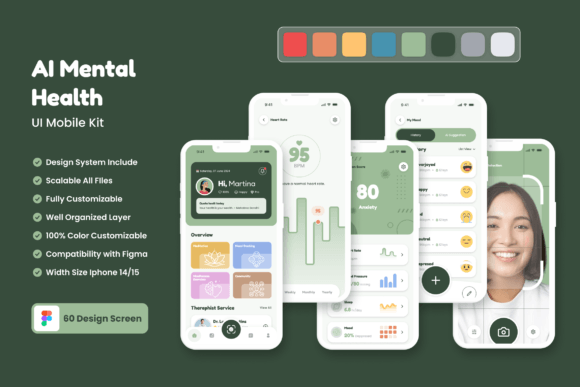
Unlike generic social media or e-commerce templates, a mental health application demands a specific visual language. Colors must soothe rather than stimulate. Typography needs to be legible and gentle. The flow of information should feel supportive, not overwhelming. The Ai Mental Health App Mobile UI KIT is designed with these principles at its core. It offers a collection of twenty pixel-perfect screen designs that address the unique user journeys typical in wellness apps—from mood tracking and journaling to guided meditation and session booking.
What makes this particular resource stand out is its balance of structure and flexibility. You aren't locked into a rigid design system. The fully layered files, available in Adobe Photoshop, Adobe InDesign, and Sketch, allow you to deconstruct every element. Need to adjust the color palette to match a specific therapeutic brand? The vector layers and symbol objects make this a matter of a few clicks. Perhaps you want to swap out an icon set for one that better reflects your app's personality. The included free icon vectors and scalable assets ensure you can do so without compromising resolution or consistency.
Practical Applications Beyond the Initial Build
While the primary use case is developing a mobile application, the value of a comprehensive UI kit extends into numerous other design and branding projects. Consider the small business owner launching a therapy practice. The screens and elements within this kit can be repurposed to create cohesive marketing materials. The clean, modern typography and calming color schemes translate beautifully to social media graphics promoting mindfulness tips or workshop announcements. The same visual language can be applied to packaging design for wellness products, print materials like brochures and appointment cards, or even editorial layouts for a mental health blog.
For content creators and marketers in the wellness niche, maintaining visual consistency across platforms is crucial for brand recognition. This UI kit provides a centralized source of design assets that can inform your entire brand identity. The 80+ UI elements serve as a library of buttons, forms, cards, and navigation bars that can be adapted for website headers, email templates, or digital product interfaces. This approach ensures that a user's experience, whether they are on your app, your website, or viewing your Instagram feed, feels unified and professional.
Enhancing Communication Through Thoughtful Design
The true power of a well-crafted UI kit lies in its ability to improve audience engagement. In the context of mental health, engagement is tied to trust and comfort. A clunky, poorly designed interface can create a barrier, making users hesitant to share personal reflections or track their progress. By utilizing templates built with readability and intuitive flow in mind, you remove that friction. The careful selection of font pairings within the kit—likely combining a clear, accessible sans-serif for body text with a slightly more distinctive display font for headings—ensures that information is communicated clearly and empathetically.
When adapting these designs, think about your specific user's journey. Are you building for a younger demographic that values bold, expressive visuals, or for an older audience that prioritizes simplicity and large text? The modular nature of the kit allows you to customize screens by adding or subtracting elements. You might combine a mood tracking screen with a journaling prompt from another template, creating a hybrid flow that serves your unique application logic. This level of customization is what transforms a generic template into a tailored brand identity tool.
Key Considerations for Effective Implementation
Before diving into customization, a few practical steps will ensure a smoother workflow. First, review the full set of twenty screens to map out a logical user flow for your project. Identify which templates align with your core features and note any gaps you'll need to fill with custom design. Second, pay close attention to the commercial licensing included with your download. While the fonts and icons are free for use within the kit, confirm that the license covers your intended end product, especially if you plan to distribute the final application widely.
Next, consider the typography hierarchy. The kit's modern typography is a strong starting point, but you may need to adjust font sizes or weights to enhance accessibility. Test how the text renders on different mobile devices. Finally, don't feel confined to the original aesthetic. The 100% scalable vectors and fully editable structure mean you can shift the entire color scheme from a serene blue to a warm, earthy palette, or change the corner radii of buttons from sharp to soft. The goal is to use the kit as a robust scaffold, not a finished product.
For entrepreneurs and designers, resources like this Ai Mental Health App Mobile UI KIT represent more than just a shortcut. They are a strategic investment in quality and user-centric design. By starting with a professional, thoughtfully constructed foundation, you free up creative energy to focus on the unique value proposition of your app—the content, the features, and the supportive community you aim to build. In a field where the user's emotional state is paramount, that thoughtful design foundation isn't just nice to have; it's essential.